
Climbing Mount Olympus: Everything You Need to Know Before You Go
Mount Olympus is the highest mountain in Greece (the second highest in the Balkans), with its peak reaching 2,917 meters. Due to its status in Greek mythology as the home of the 12 gods, Olympus is renowned worldwide.
For many years, people daren’t climb Olympus, and it wasn’t until 1913 that the first climbers reached the summit of Mytikas, the highest peak of the mountain. By the way, there are 18 other mountains around the world named Olympus.
As the highest mountain in Greece and due to the mystical aura surrounding it, Mount Olympus attracts climbers, hikers, and nature enthusiasts every year.
This post focuses on information for travelers who want to summit one of the mountain’s peaks. If you want to visit Mount Olympus as part of a family trip, you should read this post.
Quick Navigation:
- Facts about Mount Olympus
- How to Get to Olympus
- Equipment and Preparation
- Weather on Mount Olympus and Hazards
- The Trek to Mount Olympus Summit: The Classic Route
- Mountain Refuges on Mount Olympus
- Safety Rules in Olympus National Park
- Where to Stay in Litochoro and Surroundings
- Hiking Trails and Other Points of Interest
1. Facts about Mount Olympus
Mount Olympus National Park is located about an hour’s drive from Thessaloniki Airport.
The base town for most travelers is Litochoro. Before and after the climb, you can explore the area and stay in Litochoro or one of the surrounding towns.
The mountain climb mostly begins at Prionia, where there is a restaurant and parking lot. The road from Litochoro to Prionia is paved and relatively easy (the last few meters are on a dirt road).
The first section of the ascent to the summit, on the standard route that most climbers take, is to the Spilios Agapitos Refuge, which is at an elevation of 2,100 meters and about a 3-hour brisk walk from Priònia.
This refuge has over 100 beds, electricity, and even cellular reception. Reservations for the refuge must be made in advance. You can take a very cold shower, there is a restaurant, and the lights are turned off precisely at ten o’clock in the evening. The route from Priònia to the refuge is approximately 4.6 kilometers long.
The route to the summit is part of the E4.
The trail from Litochoro to the summit of Olympus is part of the European E4 trail.
There are currently 11 trails in Europe marked E1 to E11 that cross several countries. The E4 trail starts in Spain and ends in Cyprus, passing through Greece.
The full length of the trail is approximately 10,500 km in its short version and about 11,500 km in its full version.
It is designed for a journey of 520 days making it not suitable for everyone.
By the way, even families can experience parts of the E4 trail, such as a short hiking route starting from Litochoro that joins the E4 and is called the Zeus Baths. There are also parts of the trail from Litochoro to the A Refuge.
Do Not Climb to the Summit Without a Guide
Climbing to the A Refuge is one thing; but reaching the actual summits of Mount Olympus is highly recommended to be done only with a guide. In addition, proper preparation, clothing, and all necessary equipment (e.g., helmets for protection against falling rocks) are required.
I will include a link to guides and organized tours to the summit later in the post.
Beware of Excessive Self-Confidence
Fatal accidents occasionally occur on the mountain, mainly due to two reasons: excessive self-confidence of the climbers and unpredictable weather conditions.
The weather on Mount Olympus is volatile and often unstable. For instance, a storm with strong winds can start suddenly, posing a real danger to inexperienced climbers.
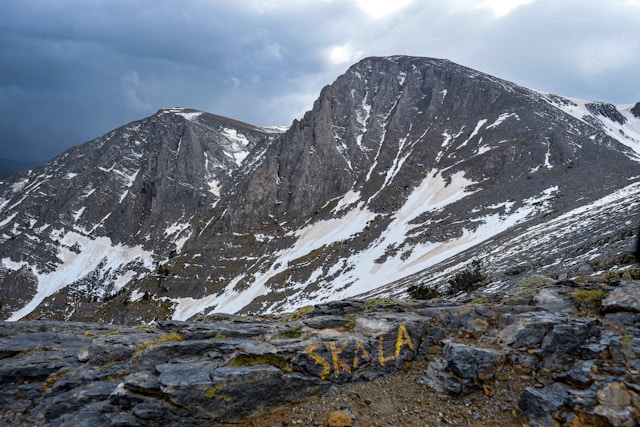
Some climbers settle for ascending from the refuge to one of the secondary peaks, such as Skala at 2,860 meters, which also offers breathtaking views. From Skala, you can continue climbing to the Skolio summit, slightly above 2,900 meters.
However, even climbing to secondary peaks should only be done with proper guidance and experience!
Vegetation on the Mountain
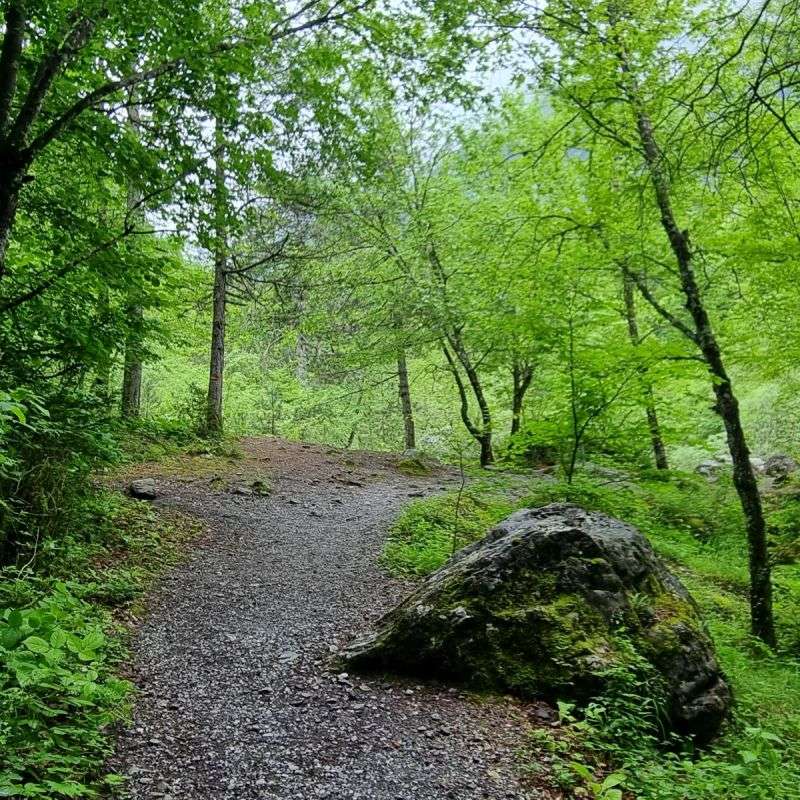
The most accessible area of Olympus is around the Enipea River, offering excellent hiking trails. The experience is unique, and it’s worth dedicating some time before or after the summit climb to explore the park at lower elevations.
The vegetation around the mountain is generally divided into four altitude zones: up to 500 meters above sea level, low-growing trees such as: laurel and oak. From 500 meters up to 1,400 meters beech, pine, and fir trees; from 1,400 to 2,500 meters, mainly conifers; and above 2,500 meters, mainly alpine pasture.
2. How to Get to Mount Olympus
Mount Olympus is only about an hour and a quarter from Thessaloniki Airport and about 5 hours from Athens, so if you plan to climb Olympus, it’s better to land in Thessaloniki.
If you want to get about with a rented car, you can leave your car in the Prionia parking lot (which can be a bit crowded during peak season). Another option is to park in Litochoro.
For car rentals in Thessaloniki, check out the rental company Chalkidiki-Cars. You can find a detailed post about car rentals in Thessaloniki here.
By public transportation: If you don’t have a car, you can take a bus from Thessaloniki to Katerini and from there to Litochoro. You can also take a bus from Athens on the same route. Several buses depart daily. For schedule information, see here.
In Litochoro, the bus stops right in the town center.
You can also reach Litochoro by train, but then you will need a taxi from the train station to Litochoro.
To get from Litochoro to Prionia – in the summer, there is a bus route that goes from Litochoro to Prionia, which is cheap and convenient. Another option is a taxi (about a 30-minute drive).

3. Equipment and Preparation for the Olympus Trek
Experts divide the activity on the mountain into three levels: the first is walking – a low difficulty level suitable for families and children.
The second level is mountain hiking, usually requiring a longer distance and sometimes simple climbing techniques.
The third and most difficult level is mountaineering.
For a trek to the summits of Olympus.
you need to understand that mountaineering techniques are required, and this is not just another trail for avid hikers.
For climbing the mountain, you need suitable shoes, trekking poles, a helmet, harnesses, warm clothing, a charged mobile phone (despite poor reception in most of the mountain area), and you should never go alone.
There is a hiking gear shop in Litochoro, which is not particularly cheap. Some equipment can be rented at the refuges, but check this in advance. If you join a group, you will receive the necessary equipment.
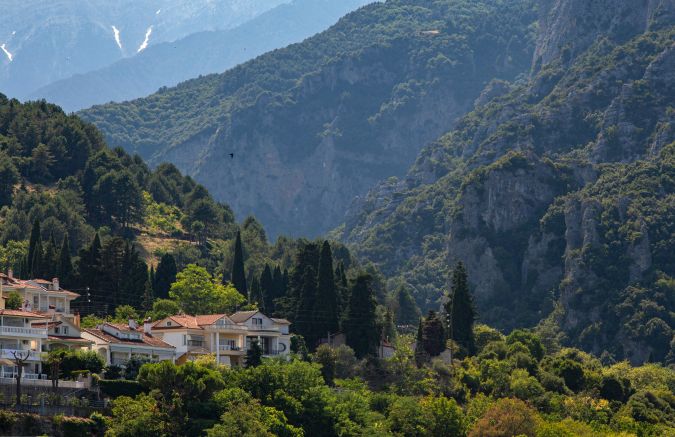
4. Weather on Mount Olympus and Risks
The weather on Olympus can change dramatically and quickly.
Rain and sudden storms can occur at any time, but they are more common in spring and summer compared to autumn.
Such conditions can suddenly cause rockfalls, for example.
If you plan a trek to one of Olympus’s summits or even just to the A Refuge (2,100 meters), most local guides recommend visiting between June and November.
The most suitable times for climbing Olympus are late spring and autumn.
Autumn on Olympus is usually mild and dry, lasting from mid-October to the end of November, offering good conditions for hiking with less unpredictable weather.
Darkness falls early in autumn, so adjust your departure times accordingly. In some areas of Olympus, it gets even darker earlier due to the mountains obscuring the valleys.
The first snow usually falls in December or January, and in areas above 2,000 meters, snow can remain until the end of June. There are shaded areas at the base of slopes and cliffs, such as valleys hidden by high slopes, where the snow never melts.
Spring is also mild, but there is a lot of melting snow, and it takes time to melt, even in lower areas.
Summer on Olympus is hot during the day but cool at night. On high peaks, even in summer, temperatures can drop below freezing.
5. Guided Tours to Mount Olympus Summits
If you are planning your first ascent or traveling solo, joining a guided group can simplify the logistics of mountain refuges and route finding.
Professional guides ensure a safer experience while reaching the highest peaks.
You can browse various guided climbing options and view pricing through this link.
6. The Classic Mount Olympus Summit Trek
The recommended way to undertake the trek to the summit of Mount Olympus is as part of a group led by a professional guide.
Below is a description of the classic route, along with a link to register for a climbing group that offers this tour.
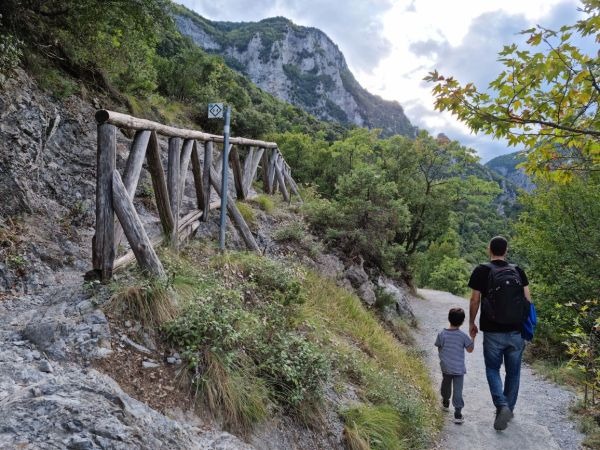
The trek lasts for two days: starting in the morning in Litochoro and from there, a car drive to Prionia. After a brief preparation, the ascent begins towards Refuge A via the European Trail E4. The trail climbs among pine, fir, and spruce trees, and much of the route is shaded from the sun. The trail is well-marked and eventually leads to the refuge. Here, you can enjoy a rest, have dinner, and sleep in preparation for an early wake-up the next day.
At dawn, head out and climb to the summit
The next morning starts very early, before dawn, with a light breakfast on the refuge’s terrace. Immediately after, the exciting journey to the summit begins. The trail offers a spectacular view of the eastern part of Olympus, and after about two hours, you reach the Skala summit at 2866 meters. There, you take a short break and equip yourselves with helmets and climbing harnesses in preparation for the Mytikas summit.
After overcoming the most challenging physical section, a climb of 700 meters, you are rewarded with breathtaking views of the Skolio summit (2911 m), the Agios Antonios summit (2815 m), and the summit of Mytikas (2918 m).
The ascent is done with the entire group connected to each other.
After another hour, you reach the Mytikas summit at 2,918 meters—the highest point in Greece. Throughout the ascent, climbers will be securely connected to the guide’s rope and will receive guidance at each stage of the climb.
At the summit, take a moment to rest, take photos, and marvel at the amazing views and surrounding peaks. Afterwards, begin the descent back to the refuge via the same route.
If you are interested in joining a group for this trek, check the option here.
If you have less time and are adventurous enough, consider another option: a route starting from the western side of the mountain from the town of Kalyvia. This involves starting with off-road vehicles to Refuge Christaki and then walking. This is considered the shortest route to the Mytikas summit (though not necessarily the easiest!). For more details, check this option
7. Mount Olympus Hiker Refuges
There are several refuges on the mountain, some equipped with electricity, a restaurant, and toilets, while others are emergency shelters, meaning they provide basic shelter with an unlocked door, and sometimes beds and bedding. Here is an initial overview of the refuges, but make sure to contact each one before your arrival to confirm opening times, availability, etc.
Spilios Agapitos Refuge
The most popular route for hikers to the summit starts at Prionia and passes through the Spilios Agapitos Refuge, also known as Refuge A.
Located at 2100 meters, the refuge is about a 4.6 km walk from Prionia, with a 1000-meter elevation gain. The walking time only is approximately 3 hours. This refuge has over 100 beds, electricity, and even a (weak) cellular reception.
Opening: May to October, accommodating 110 people. It has electricity, a restaurant, and toilets.
It is the busiest refuge on the mountain, so reservations are necessary, and a deposit is required by credit card. Those continuing to the Mytikas summit can rent helmets at the reception. There is internet access, but it is quite slow due to many users. For the refuge’s website, click here.
Giosos Apostolidis Refuge
Located at 2697 meters, it has electricity, a restaurant, and toilets. It can accommodate up to 80 hikers, though there is no running water, however bottled water is available for purchase. This refuge is the closest to the high peaks of Stefani and Mytikas. For the refuge’s website, click here.
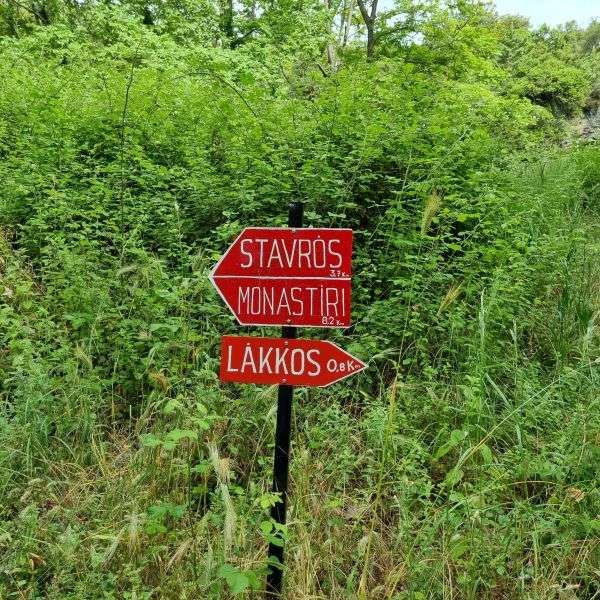
Stavros Refuge - Shelter D
This is essentially a restaurant, though there is also an option for lodging. It is not a classic refuge as it is located on the road from Litochoro to Prionia. There is a walking trail that leads to Stavros starting in the heart of Litochoro.
Petrostrouga Refuge
This refuge is located at 1940 meters, it is open from May to October, and on winter weekends. The refuge has electricity, a restaurant, and toilets, and can accommodate up to 72 hikers.
The refuge is accessible only by foot, but the trail leading to it is relatively wide, well-marked, and takes about two hours of moderate walking. The trail starts at a point called Gkortsia, located on the road from Litochoro to Prionia, about 4.5 kilometers before Prionia. At this location, there are stables where the mules carrying the equipment to the refuges are kept.
You can start a 5.5 km route from here to the refuge; this route is considered slightly more challenging than the route from Prionia, although in my opinion the elevation gain is slightly less. For the refuge’s website, click here.
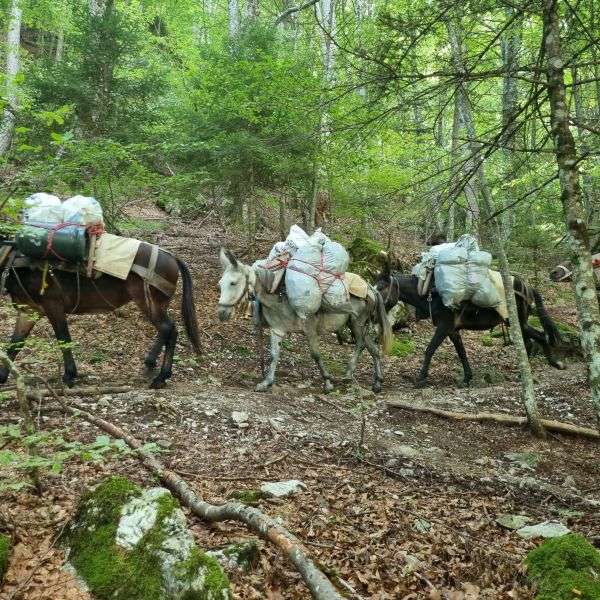
Koromilia Refuge Olympus
This refuge is located at 1020 meters, it is open from May to October and additionally on weekends in the winter. The refuge has electricity, a restaurant, and toilets, and can accommodate 18 people.
This refuge is located in the northeastern part of Olympus, two hours’ walk from the end of the asphalt road. The trail starts near the Orlias Falls, with a staircase climbing up the mountain. Be sure to check the sign indicating whether the refuge is open or closed (see photo).
An alternative way to reach it is an 8 km dirt road. The refuge is considered child-friendly and offers vegetarian and vegan options in its restaurant. For the refuge’s website, click here.
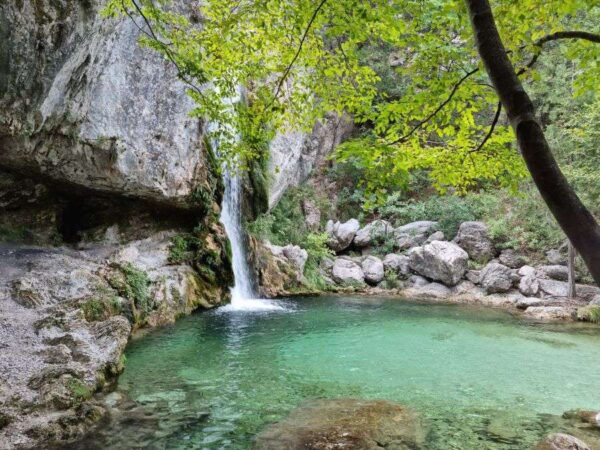
KREVATIA REFUGE
This refuge is located at 1005 meters, it is open year-round but only on weekends. It has electricity, a kitchen, and toilets.
The refuge is about a 2-hour walk from Agios Apostoli, at the end of the asphalt road from the village of Vrontou. The trail is considered of medium difficulty.
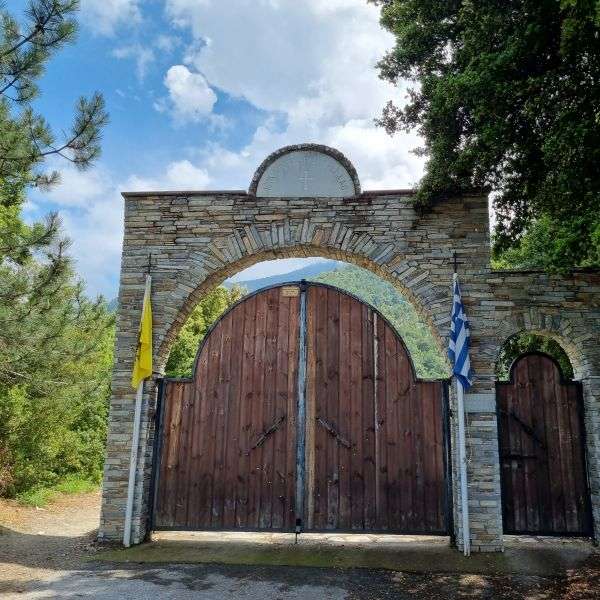
From Agios Apostoli (the northern gateway to the Olympus Reserve), continue on the middle road, cross the bridge, and turn left at the next junction until you reach the monastery.
To the left of the monastery, you will see a sign directing you to the trail. From here, the refuge is about 2 kilometers away.
8 . Safety Guidelines For The Olympus National Park
- Park your vehicle in a safe place, do not block traffic or park in ditches at the ends of the road.
- Walk only on marked trails.
- Fires are prohibited on the mountain throughout the year.
- Do not throw cigarette butts on the ground.
- Camping is only allowed in designated areas.
- Access to the reserve is allowed only via marked paths, and using the trails is permitted from sunrise to sunset only.
- Children under 14 must not enter unaccompanied.
- Parking is prohibited in non-designated areas.
- Cutting trees, uprooting and collecting shrubs, plants, or seeds is prohibited.
- Lighting a fire and camping in the reserve is forbidden.
- Hunting any animal by any means is prohibited year-round.
- Destroying or collecting nests, eggs, or chicks and generally disturbing or damaging wildlife or geological formations is prohibited.
- Disturbance of the free movement of wildlife is forbidden.
9. Where to Stay in Litochoro and the Mount Olympus Area
The Olympus area offers a wide range of hotels, guesthouses, and hostels. If you are climbing to the summit, you will likely spend a night in one of the hiker refuges.
Before and after the climb, or as part of a family trip, you can stay in Litochoro or one of the nearby towns surrounding the mountain. Litochoro is a pleasant town located at the base of Mount Olympus, offering a variety of hotels, guesthouses, restaurants, and shops.
There are many accommodation options around Olympus outside of Litochoro as well. You can stay in one of the nearby coastal towns, such as Platamon. Another popular option is the wonderful mountain village of Palaios Panteleimonas.
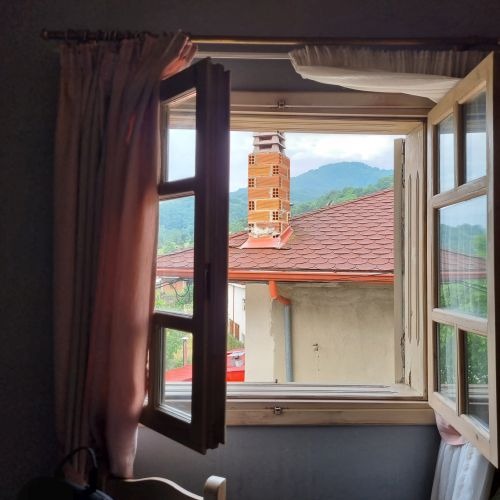
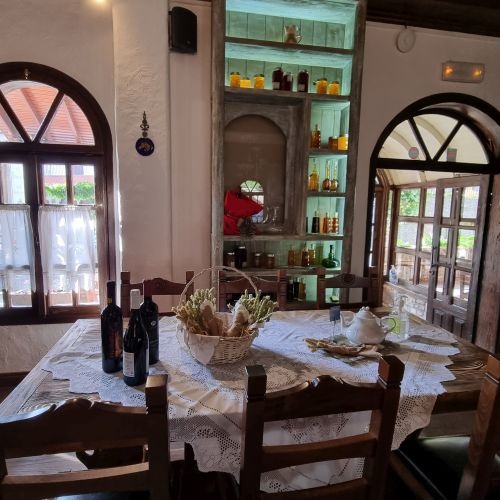
A charming hotel on the western side of Mount Olympus
10. Hiking Trails and Additional Points of Interest
If you have reached Mount Olympus, don’t limit yourself to just the summit trek, despite the thrilling experience it provides. It is worthwhile to dedicate a day or two (or three) to explore the entire reserve. See this post for the main points of interest around the mountain.
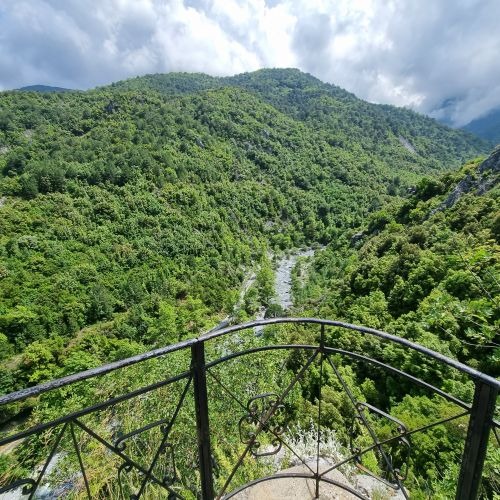
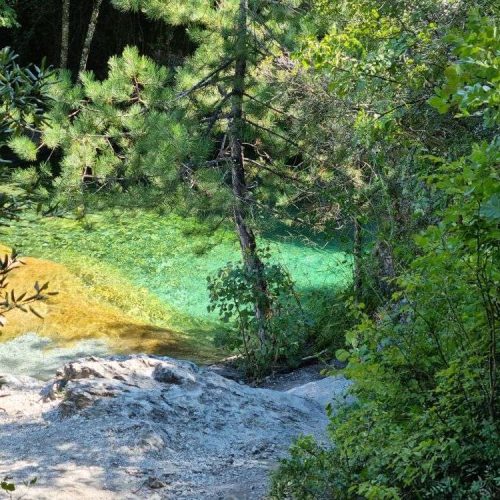
Agia Kori Waterfalls and a beautiful viewpoint from the nearby monastery